

What if a perfectly cut key still won’t start your car? The missing step may be transponder key programming, which pairs the chip inside the key with your vehicle’s immobiliser. If the chip isn’t recognised, the engine may not start, even when the key blade turns in the lock.
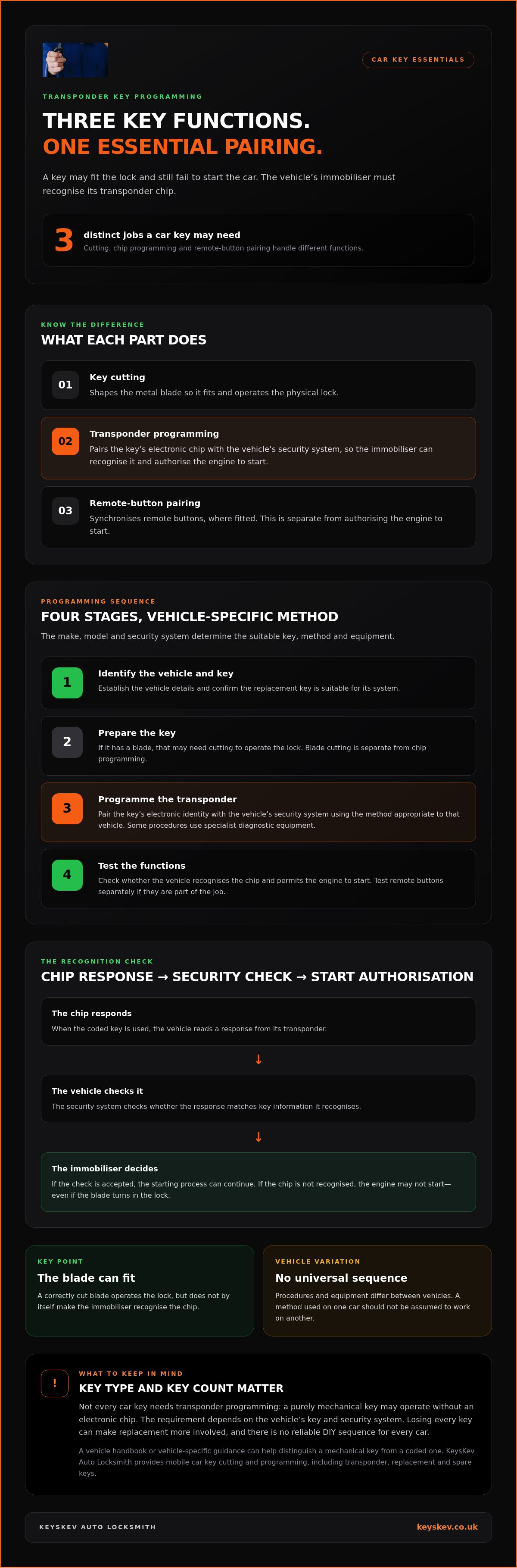
It’s easy to confuse programming with cutting a key or pairing its remote buttons. They’re separate jobs. Cutting shapes the blade to fit the lock; programming lets the car recognise the key’s chip. Remote buttons may need pairing too, depending on the vehicle.
This guide explains how the key chip and immobiliser communicate, what happens during programming and why the method varies between vehicles. You’ll also learn what to expect if you need a replacement, including why losing every key can make the process more involved. KeysKev Auto Locksmith provides mobile car key cutting and programming, including transponder keys. Understanding which functions your key needs can help you explain the situation clearly and arrange the right service.
Key Takeaways
- Transponder key programming pairs the key’s chip with the vehicle’s immobiliser so the car can recognise it.
- The process generally involves identifying and preparing the key, programming it, then testing it. The method varies by vehicle.
- Key cutting, chip programming and remote-button pairing handle different functions. Knowing which one is needed can help you describe the problem clearly.
- There’s no reliable DIY sequence for every car. Some vehicles need specialist equipment or procedures.
- KeysKev provides mobile car key cutting and programming, including transponder, replacement and spare keys.
What is transponder key programming, and why does your car need it?
Transponder key programming pairs a key’s electronic chip with a vehicle’s immobiliser so the car can recognise the key and authorise the engine to start.
When you use a coded key, the vehicle checks the chip’s response against the security information it expects. If the response is accepted, the immobiliser allows the starting process to continue. If it isn’t recognised, the engine may not start, even if the blade fits the lock and turns. That’s why a replacement key can look right but still need electronic programming.
Programming changes the electronic relationship between the key and the vehicle. It doesn’t shape the metal blade. Key cutting creates a blade that fits the vehicle’s lock, while programming deals with the chip’s recognition by the immobiliser. Some keys also have remote buttons or smart-key functions. Those features serve different purposes and shouldn’t be assumed to work just because the transponder is programmed.
How does a transponder chip communicate with the immobiliser?
A transponder is a small electronic component inside or attached to a key. When the key is used, the vehicle reads a coded response from the chip and checks whether it matches the key information recognised by its security system. The immobiliser helps prevent unauthorised starting by allowing the engine to start only when the required key check is accepted.
The exchange happens electronically, without the driver needing to enter a code. The exact technology can differ between vehicles, so there isn’t one universal explanation of every signal or security step. The practical point is straightforward: a cut blade can operate a lock, but the car’s immobiliser must also recognise the chip for the engine to be authorised.
Does every car key need transponder programming?
No. The requirement depends on the vehicle’s key and security system. An older, purely mechanical key may operate the lock without an electronic chip. A key designed to be recognised electronically may need programming, particularly if it’s a replacement or spare. There isn’t a single model-year cut-off that reliably tells you which type your car uses.
Check the vehicle handbook for information about its key system, or ask KeysKev for vehicle-specific guidance. This can help distinguish a mechanical key from a coded one before arranging a replacement. It also avoids confusing transponder key programming with pairing remote buttons, which controls a separate function on some keys.
How transponder key programming works: identification, pairing and testing
Programming procedures are vehicle-specific. The vehicle’s make, model and security system determine the suitable method, equipment and key type. The work follows a clear sequence, but it isn’t a universal set of steps that applies to every car.
- Identify the vehicle and key. The vehicle details and replacement key type are established first. The key must be suitable for the vehicle’s system.
- Prepare the key. If it has a blade, that blade may need cutting to operate the physical lock. This is separate from programming its transponder chip.
- Programme the transponder. The key’s electronic identity is paired with the vehicle’s security system using the method appropriate to that vehicle. Some procedures use specialist diagnostic equipment, often connected through the vehicle’s diagnostic port.
- Test the key. The vehicle is checked to see whether it recognises the chip and permits the engine to start. Any remote buttons are tested separately if they’re part of the job.
What happens before a transponder key is programmed?
First, the vehicle and replacement key are identified. A key can have the right shape yet use an unsuitable electronic component, so its type matters as much as the blade. If the replacement has a blade, cutting it is a distinct physical task. The vehicle’s security system then determines the appropriate programming method. Procedures and equipment can differ between models.
This is why a diagnostic tool or method used on one car shouldn’t be assumed to work on another. Transponder key programming is the electronic pairing stage, not a generic sequence of button presses. Smartphone-based digital keys are a separate development, with the Car Connectivity Consortium working on standards for connected vehicle access and security. Its overview of the future of car key technology and security standards provides useful context, but it doesn’t replace the procedure for a conventional transponder key.
How is a programmed transponder key tested?
The essential check is whether the vehicle recognises the programmed chip and allows the engine to start. This confirms the immobiliser is responding to that key. It doesn’t necessarily confirm that every other key function works.
Remote locking buttons control a different function from engine-start authorisation. If the key includes a remote, its buttons may need separate synchronisation and testing. A key might start the car while its remote buttons still need attention, or operate the locks without the transponder being accepted. Testing the functions separately makes the result clearer.
KeysKev provides mobile car key cutting and programming, including replacement and spare keys. The service can cover both the physical blade and electronic programming, while keeping each task distinct.
Transponder programming vs key cutting and remote fob pairing
A car key can perform several jobs, but they aren’t all handled by the same process. A blade may open a lock, a transponder chip may authorise the engine to start, and remote buttons may lock or unlock the doors. One key can combine these parts, yet each function may need its own work.
| Task | What it changes | What it’s for |
|---|---|---|
| Blade cutting | The physical shape of the key blade | Operating a mechanical lock or ignition |
| Transponder programming | The electronic pairing between the chip and vehicle | Engine-start authorisation |
| Remote fob pairing | The connection between the remote and vehicle | Button functions such as locking and unlocking |
What does key cutting do compared with programming?
Key cutting shapes a metal blade so it operates the vehicle’s mechanical lock or ignition. It changes the blade, not the electronic identity stored in a transponder. Programming, by contrast, pairs that chip with the vehicle’s immobiliser so the car can recognise it for starting. Depending on the key design, a replacement may need both tasks, only one, or a different combination of work.
That difference helps explain why a key can fit the door but still fail to start the car. The blade may be cut correctly while the chip hasn’t been paired. Equally, a programmed chip won’t make an incorrectly shaped blade turn in a mechanical lock. Each part has a separate job.
Is transponder programming the same as remote fob programming?
No. Transponder key programming concerns whether the vehicle accepts the chip for engine-start authorisation. Remote pairing concerns whether buttons send the right commands to the vehicle. Both functions may sit inside one key, but they aren’t necessarily programmed together. The process depends on the key design and vehicle.
For example, a car might start with a key whose remote buttons don’t lock the doors. The reverse can also happen: the remote may operate the locks, but the engine may not recognise the transponder. A weak remote battery can affect button operation, but replacing it doesn’t pair a chip with the immobiliser. If the engine won’t recognise the key, that’s a separate issue from remote-button response.
Describe the symptom clearly: does the blade fail to turn, does the engine refuse to start, or do the remote buttons fail? That distinction helps identify whether cutting, chip programming, remote pairing, or more than one task may be needed. KeysKev handles mobile car key cutting and programming, including replacement and spare keys, with the work matched to the key’s functions.
Can you programme a transponder key yourself? Understand the limits
Sometimes, but there’s no reliable DIY sequence for every vehicle. Some manufacturers provide an owner-programming procedure for particular models and key types. Others require specialist equipment or a vehicle-specific process. A method that works for one car isn’t proof it’ll work for yours.
When might an owner-programming method apply?
Start with the vehicle handbook. It may explain whether your exact model supports owner programming, and which key types or circumstances the procedure covers. Follow that guidance only as written. If the instructions don’t match your vehicle or replacement key, don’t assume a similar-looking process will apply. Security systems differ, and some modern vehicles require specialist equipment to pair a key.
DIY may be an option when the manufacturer explicitly describes a suitable procedure and you have the specified key and any required existing keys. If the handbook gives no applicable method, the key isn’t recognised, or all keys have been lost, a specialist procedure may be needed. Avoid online instructions that promise one sequence for every vehicle. Transponder key programming depends on the vehicle’s security system, not just the appearance of the key.
Don’t try security-code workarounds or attempts to bypass the immobiliser. They don’t establish that a key is suitable or correctly paired. If you’re unsure whether the problem is the chip, remote buttons or the blade, describe what the key does to KeysKev so the issue can be assessed.
What should you have ready before arranging programming?
A few details make it easier to explain the problem and identify the right next step. Note the vehicle’s make, model and year, whether the key is new, a spare or a key that has stopped working, and how many working keys remain. Then describe the symptoms clearly.
- Starting: Does the engine start with the key?
- Locking and unlocking: Do the remote buttons operate the doors?
- Physical key: Does the blade operate the lock or ignition?
- Key availability: Do you have a working key, or have all keys been lost?
These details help separate a transponder recognition problem from an issue with the blade or remote. Don’t try an unverified procedure just to see whether it works, particularly if the handbook doesn’t describe it for your vehicle. Clear information is more useful than a guess at the cause.
If you need a replacement or spare, arrange mobile car key cutting and programming with KeysKev. The service includes transponder keys, with cutting and programming handled as part of automotive locksmith work.
Need transponder key programming? How KeysKev can help
A replacement key has to suit the vehicle and do the job you need it to do. KeysKev provides mobile car key cutting and programming, including transponder keys. Whether you’ve lost your only key, need a spare or have a key the car doesn’t recognise, explaining the situation clearly helps focus the conversation on the right type of support.
What key programming support does KeysKev provide?
KeysKev’s mobile auto locksmith work covers car key cutting and programming. This includes replacement and spare keys, transponder keys, remote and flip keys, and key cloning. The right work depends on the key and the vehicle. A replacement may involve cutting a blade, programming its transponder, or preparing a key with remote functions. These are distinct tasks, even when they relate to one key.
If you’re arranging a spare, say whether you have a working key and what you want the new one to do. If your key has stopped working, describe the symptoms rather than assuming the cause. For example, explain whether the engine starts, whether the buttons operate the locks, and whether the blade turns. Those details help distinguish a key programming issue from a problem with another key function.
What happens when you arrange help with a transponder key?
Have the vehicle’s make, model and year ready. Then explain whether the key is lost, newly cut, intended as a spare, or present but not recognised. Mention how many working keys remain. If the key has remote buttons, note whether they lock and unlock the vehicle. This gives a clear starting point for discussing transponder key programming and any related cutting or key work.
It’s also useful to describe what changed. Did the key stop working suddenly, or is it a new replacement that won’t start the car? Does it operate the lock but not the engine, or do none of its functions work? Specific observations are more helpful than a guess about which electronic part has failed. KeysKev can discuss the car key cutting and programming required for replacement and spare keys, with the work suited to the vehicle’s system.
For a broader overview of the process and key options, see this car key programming guide. It covers the wider subject beyond transponder pairing.
If you need help with a car key, get in touch with KeysKev about key programming. Share the vehicle details and explain which functions are affected so the conversation can start with the facts.
Make your next key decision with confidence
If a key isn’t behaving as expected, note exactly what happens before arranging help. Does the engine fail to recognise it, are the remote buttons unresponsive, or has the key gone missing? Clear observations give an automotive locksmith a more useful starting point than a guess at the fault.
Transponder key programming is a vehicle-specific job, so having your car’s make, model and year to hand can help focus the conversation. You can also explain whether you have another working key and what you need from a replacement or spare. KeysKev provides mobile auto locksmith support 24/7, with car key cutting and programming, key cloning and vehicle module programming among its services.
Take the next step with the details you have to hand. Get help with car key programming from KeysKev and share what’s happening with your key. A clear description can help you move towards the right support with confidence.
Frequently Asked Questions
What is transponder key programming?
It’s the process of setting up a vehicle to recognise the electronic identity of a particular key. This matters if a replacement or spare key has a chip the car hasn’t learnt to accept. A key may look identical to the original, yet still be rejected by the vehicle. KeysKev can help establish whether the key needs programming or another type of attention.
How does a transponder key communicate with a car?
The car reads a coded response from the key’s chip when the key is presented, then checks whether that response is recognised by its security system. Think of it as an electronic check alongside the physical key. A copy that matches the original blade may operate a lock but still fail this check if its chip isn’t recognised. The precise system varies between vehicles.
Can I programme a transponder key myself?
Only if the vehicle manufacturer provides a procedure for your exact model and key type. Look in the handbook for owner-programming guidance, and don’t assume instructions for a similar model apply. Some vehicles require specialist equipment or a specific security procedure. If the handbook doesn’t cover your situation, or you’ve lost every key, KeysKev can help with mobile car key programming.
Does a transponder key need cutting as well as programming?
It depends on the key and what you need it to do. A replacement with a metal blade may need that blade cut to operate the door lock or ignition, as well as electronic work for the car to recognise it. A key that has no blade, or an existing key with a physical fault, presents a different situation. Describe both the lock and starting symptoms.
Can a car start if the transponder chip is not programmed?
If the vehicle relies on a transponder check, an unrecognised chip won’t normally authorise the engine to start. The exact symptom can differ by vehicle, so a failure to start doesn’t prove the chip is the cause. Note any warning message and whether another key starts the car. Those details can help distinguish a key recognition issue from another fault.
What should I do if my car does not recognise its transponder key?
If you have another working key, try it and note whether the car responds differently. Don’t force the key or follow an unverified programming sequence. Record the vehicle’s make, model and year, whether the key is new or previously worked, and which functions fail. If the issue continues, share those details with KeysKev so the symptoms can be assessed without guessing.


