
The dealership isn’t your only route when your car key has gone missing. Lost car keys replacement can feel like a dead end when you have no working key to access or start your vehicle, but the right option depends on your car’s key system and the help you need.
A replacement must do more than fit the lock. Many modern keys also need programming to communicate with the vehicle, so it matters whether the service can handle both the cut and the electronics. This guide compares dealerships and mobile auto locksmiths, explains what details and documents to prepare, and outlines how a replacement key is cut and checked.
A mobile auto locksmith can cut and programme a replacement at your vehicle. The make, model and key type affect the process, so gather your registration details, vehicle identification number (VIN) and proof of ownership before arranging help. These details give the replacement process a clear starting point.
Key Takeaways
- Lost car keys replacement may involve cutting a physical key, programming its electronics, or both, depending on your vehicle.
- Compare a dealership and a mobile auto locksmith by considering whether the car can be driven and where the work can take place.
- Have your vehicle’s make, model, year and registration details ready when arranging help.
- A replacement key’s blade and electronic functions are prepared and checked separately.
- KeysKev provides mobile replacement key cutting and programming, including remote keys and transponders.
Lost car keys replacement: what are your options?
Losing your car keys can disrupt work, school runs and everyday plans. Lost car keys replacement means arranging a key that works with your vehicle. That may require cutting a physical blade, programming electronic functions, or both. The right route depends on your vehicle’s key system and whether you still have a working key.
If every key is missing, the replacement may need to be made without an original to copy. That can involve different work from replacing a damaged key or adding another key when you have a spare. A working spare may let you use the car while arranging a replacement, but it’s still worth considering what you’ll do if that spare is lost or stops working.
What does a lost car key replacement involve?
Some keys have a metal blade that must be cut to operate the vehicle’s locks. Others also contain a transponder, an electronic chip that communicates with the vehicle, or remote buttons for functions such as locking and unlocking. A replacement may need a blade, electronic functions, or both, prepared to suit the vehicle.
The make, model, year and key system all affect the work involved. Two keys that look alike may have different electronic functions, so appearance alone doesn’t show whether a replacement will operate your car.
Why the replacement route depends on your situation
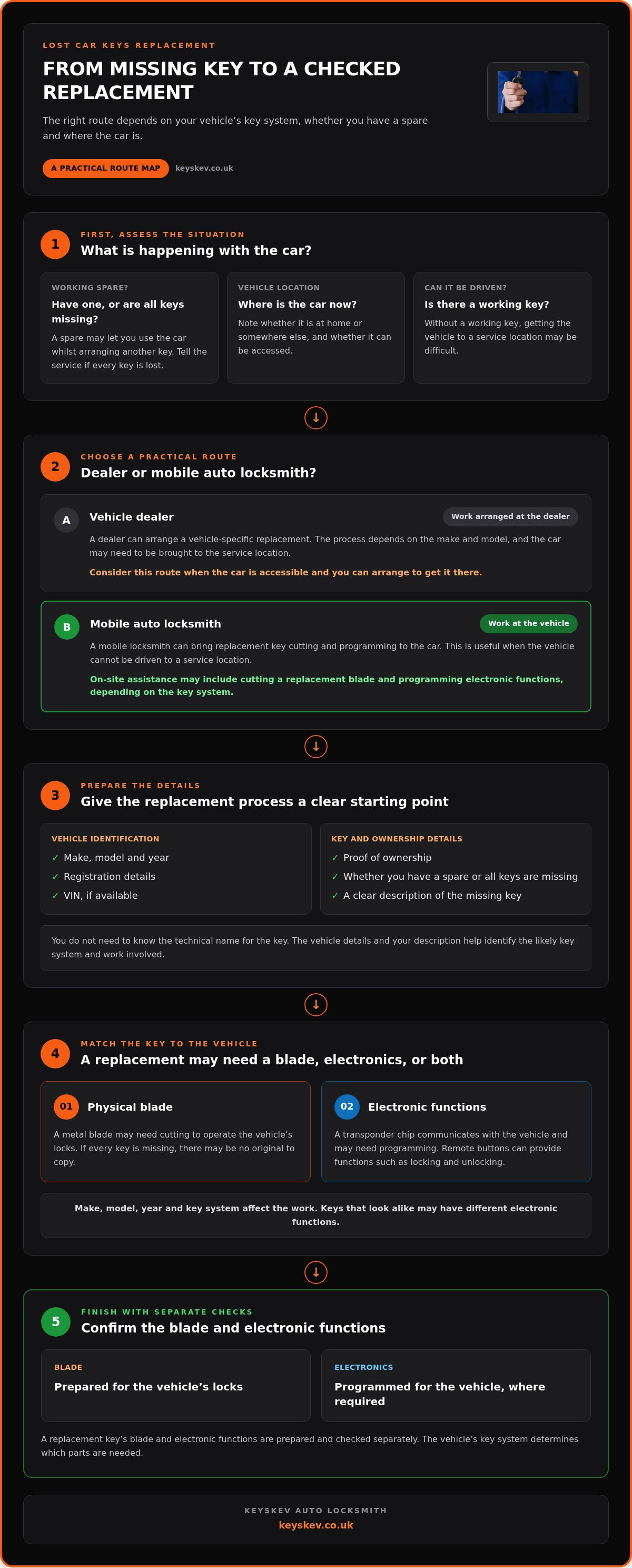
The vehicle’s location matters. If it’s at home and can be driven, taking it to a dealer may be practical. If it can’t be driven because there’s no working key, a mobile auto locksmith can carry out key cutting and programming at the vehicle, avoiding the need to get it to a service location.
A spare changes the immediate situation: you may be able to use the car while arranging another key. If every key is lost, explain that when arranging help. In either case, the vehicle details and key system help determine the work involved.
Your main options are a vehicle dealer or a mobile auto locksmith. A dealer can arrange a replacement for the vehicle, with the process depending on its make and model. A mobile auto locksmith brings the work to the vehicle and can cut and programme replacement keys for vehicle-specific electronic systems.
Before deciding, note whether you have a working spare, where the car is, and whether it can be driven. Have the make, model and year ready too. These details help identify the likely key system and clarify what the replacement process involves. The next step is to compare how dealer and mobile locksmith routes work in practice.
Dealer or mobile auto locksmith: compare lost car key replacement routes
A vehicle dealer and a mobile auto locksmith can both help arrange a replacement key. The practical difference is where the work takes place and how the vehicle can be accessed. For lost car keys replacement, consider whether the car can be driven, what type of key it uses, and whether you need help at the vehicle.
| Route | Location | Vehicle access | Typical assistance |
|---|---|---|---|
| Vehicle dealer | At the dealer or as arranged with them | The vehicle may need to be accessible, depending on the process | Vehicle-specific replacement key arrangements |
| Mobile auto locksmith | At the vehicle | Useful when the car cannot be driven to a service location | On-site key cutting and programming |
When a dealer replacement route may suit
A dealer is one option for vehicle-specific key assistance. Explain whether you have a working key or have lost them all. The process depends on the vehicle and the arrangements made. The car may need to be brought to the dealer, which can be difficult if no working key is available.
This route may be practical if the car is accessible and you can arrange to get it to the service location. If it’s immobilised at home or elsewhere, consider how it will be accessed before choosing this route.
What mobile auto locksmith assistance can do
A mobile auto locksmith brings key work to the vehicle. This is useful when the car cannot be driven because its keys are missing. Depending on the vehicle’s key system, assistance may include cutting a replacement blade and programming the key’s electronic functions on site.
Replacement options include remote and flip keys, as well as transponders. A transponder communicates with the vehicle’s security system, so the key may need programming as well as cutting. The International Association of Automotive Locksmiths, a division of ALOA, focuses on automotive locksmithing and provides training and resources for professionals in the field.
KeysKev provides mobile replacement key cutting and programming for vehicle-specific electronic key systems. Explore KeysKev’s mobile auto locksmith services to learn about the available assistance.
Start by considering the vehicle’s location. If it can be driven, a dealer may be a workable route. If it cannot, a mobile locksmith can bring key cutting and programming to the car. The make, model, year and key type help establish what the replacement involves, so have those details ready when arranging help.
What to prepare before arranging a lost car key replacement
Having a few details ready can make it easier to identify the right type of key and plan the work. For lost car keys replacement, start with the vehicle’s basic details, then describe the missing key and explain where the car is. You don’t need to know the technical name for the key; a clear description is useful.
Vehicle details that help identify the key system
Use the registration, make, model and year as your starting point. These details help identify the vehicle and narrow down which key system it uses. If you have access to it, the Vehicle Identification Number (VIN) may also help identify the vehicle’s specifications. Describe the missing key as accurately as you can, even if you’re unsure of its exact type.
- Essential: Have the vehicle registration, make, model and year to hand.
- Helpful: Provide the VIN if it’s readily available, for example from vehicle paperwork.
- Helpful: Say whether the key was a conventional metal key, a remote with buttons, or a flip-style key. Mention any features you remember. Kelley Blue Book’s guide to key fob replacement also explains common key and fob types.
Documents and access information to have ready
Proof of ownership may be requested before vehicle-key work proceeds. The V5C registration certificate is useful to have nearby, alongside identification or other paperwork showing your connection to the vehicle. Explain what documents you have so the requirements for your situation are clear.
- Essential: Be prepared to provide proof of ownership if requested.
- Helpful: Keep the V5C and relevant identification or ownership paperwork accessible.
- Essential: Give the vehicle’s location and explain whether it’s accessible, parked at home or elsewhere, and whether it can be driven.
Be precise about access. For example, say if the car is in a locked garage, parked in a car park, or locked with the missing key inside. That context helps explain the practical situation alongside the key details. If the vehicle is locked as well as missing its key, read what to do when locked keys are in your car.
Gather what you can without delaying yourself to find every document. The registration, vehicle details, a description of the key and the car’s location provide a clear starting point. Share any gaps honestly, as the exact work depends on the vehicle and its key system.
How replacement keys are cut, programmed and checked
A replacement key has to suit both the physical locks and, where fitted, the vehicle’s electronic security system. The work may involve cutting a key blade, programming electronic functions, or both. The exact process depends on the vehicle’s make, model, year and key system, so there isn’t one method for every car.
Cutting and programming are separate tasks. Cutting shapes the key blade to operate the locks, while programming matches compatible electronic functions to the vehicle. A key can look right but still need programming before the vehicle recognises it.
The role of the transponder and immobiliser
A transponder is an electronic component used in some vehicle keys. It communicates with the vehicle when you try to start it. An immobiliser helps prevent the engine from starting unless the vehicle accepts the key. Systems and programming methods differ between vehicles, so a replacement must suit the particular car rather than being chosen by appearance alone.
For a key with a blade, the physical part must be cut to operate the relevant lock. A remote may also have buttons for locking and unlocking. A transponder key may need its electronic component programmed so the vehicle recognises it. Some keys combine these functions in one unit; others use a different arrangement.
With lost car keys replacement, the process may start without an original key to copy. The vehicle details help identify the key system and guide the work. A mobile auto locksmith can cut and programme replacement keys at the vehicle, tailoring the work to its requirements.
What to expect when a replacement is tested
Once prepared, the replacement may be checked for its mechanical and electronic functions. This helps establish whether the blade operates the locks and whether the vehicle responds to the key as expected. If the key includes a remote, its buttons may also be tested.
- Key blade: Check that it operates the relevant lock smoothly.
- Starting function: Check that the vehicle recognises the key, where electronic recognition is required.
- Remote buttons: Check locking or unlocking functions if the replacement includes a remote.
These checks matter because a key may perform one function but not another. For instance, a blade might turn a door lock while the electronic component still needs programming. Remote buttons working doesn’t by itself show that the key blade is cut correctly. The checks required depend on the key’s design and the vehicle system.
KeysKev provides mobile replacement key cutting and programming for vehicle-specific electronic systems, including remote keys and transponders. Learn about mobile help with replacement car keys.
Get lost car keys replacement help from KeysKev
KeysKev is a mobile auto locksmith serving customers nationally across the UK, with 24/7 assistance for lost car keys. Replacement work can include cutting a key and programming its electronic functions to suit the vehicle. Share your car’s details and explain what has happened to help define the key type and the assistance you need.
Replacement key support for different vehicle key types
Vehicles use different key designs and electronic systems. KeysKev cuts and programmes replacement keys, including remote and flip keys. Depending on the vehicle’s system, the work may also involve a transponder, the electronic component used by some keys to communicate with the car.
KeysKev also provides key cloning. Tell KeysKev if you still have a working spare or if every key is missing, as the vehicle’s make, model, year and key system determine the appropriate replacement or programming work. A key that looks similar to yours may not be compatible with your vehicle.
- Replacement keys: Cutting and programming to suit the vehicle’s key system.
- Remote and flip keys: Replacement support for these key types.
- Transponders and key cloning: Options depending on the vehicle and the keys you have.
Give a clear description: mention whether the missing key had buttons, folded into a fob, or was a conventional key. Also say whether you’ve lost every key or still have one that works. These details help establish the replacement work without assuming every vehicle uses the same process.
Take the next step when your car keys are lost
Before getting in touch, gather the vehicle registration, make, model and year. Have the VIN ready if it’s available, and keep the V5C registration certificate or other ownership documents nearby. Explain where the vehicle is and whether it’s accessible. This gives the conversation a practical starting point.
You don’t need to identify the technical key system yourself. Describe what you know and what has happened. KeysKev provides mobile assistance for lost car keys replacement, including cutting and programming replacement keys for vehicle-specific systems.
Contact KeysKev for mobile auto locksmith assistance and share your vehicle details, including whether you have a working spare.
Make your next journey easier
Once your replacement key is sorted, consider how to avoid being left without a working key again. If you have only one, arranging a spare gives you another option if that key is misplaced, damaged or stops working. Keep it somewhere separate from your everyday keys but accessible when needed.
For now, focus on the next practical step. Have your vehicle details and any ownership documents nearby, then explain whether you’ve lost every key or still have one that works. Those details help start a clear conversation about the right lost car keys replacement for your vehicle.
You don’t need to work out the technical details alone. KeysKev provides mobile assistance for your car and the key system it uses. Get mobile lost car key replacement help from KeysKev.
A missing key can throw the day off course. With a clear plan, you can get your vehicle’s key needs addressed and move forward.
Frequently Asked Questions
Can a lost car key be replaced if I have no spare?
Yes, a replacement may still be possible even if every key is missing. The work can differ from copying a key when you have an original, as the vehicle and its security system need to be identified without one. Share the car’s details and explain that no spare is available. This helps establish what lost car keys replacement involves for your vehicle.
How much does lost car keys replacement cost?
There isn’t one fixed cost for every replacement. The price depends on factors such as the vehicle, the key type and whether all keys are lost or a working key remains. A basic key and an electronic remote key involve different work. Share your vehicle details and describe the key you need replaced to discuss the job with KeysKev.
What happens if my lost car keys are later found?
If you find the missing key after getting a replacement, don’t assume it has been removed from the vehicle’s security system. Depending on the car and work carried out, it may still operate the locks or start the vehicle. Keep it secure and explain the situation to an auto locksmith, who can advise whether any action is needed to manage the found key safely.
Is a replacement car key the same as the original?
It may perform the same functions, but it won’t necessarily look identical or come from the same source as the original. What matters is that it’s compatible with your vehicle and has the functions you need, such as starting the car or operating remote buttons. Mention any features the original key had beyond basic entry and starting.
Can a replacement key work if the remote buttons are damaged?
Yes, a key may still start the vehicle even if its remote buttons are damaged, depending on the key design and condition. The remote function and the starting function aren’t always the same component. Describe what still works, such as turning the ignition or unlocking the door manually. That helps distinguish a remote fault from a key that needs replacing.
How long does it take to get a lost car key replaced?
There’s no single timescale for every vehicle. The work depends on the key system, whether an original key is available and what needs to be cut or programmed. Mobile assistance also involves reaching the vehicle, so a general estimate should not be treated as a firm appointment time. Give the vehicle details and explain your circumstances to discuss the likely process.
Do I need the V5C to get a replacement car key?
Not necessarily in every situation, but proof of ownership may be requested before key work proceeds. The V5C registration certificate is useful to have, alongside identification or other documents relating to the vehicle. If the V5C isn’t available, explain what other evidence you can provide. Requirements depend on the circumstances.
Can a replacement key be made if my car battery is flat?
A flat battery doesn’t automatically mean a replacement key can’t be prepared, but it may affect access to the vehicle or checks that rely on its electrical systems. Tell the auto locksmith the battery is flat before arranging the work. Include whether the car is locked and where it’s parked. The vehicle’s key system and condition determine the practical steps needed.


