

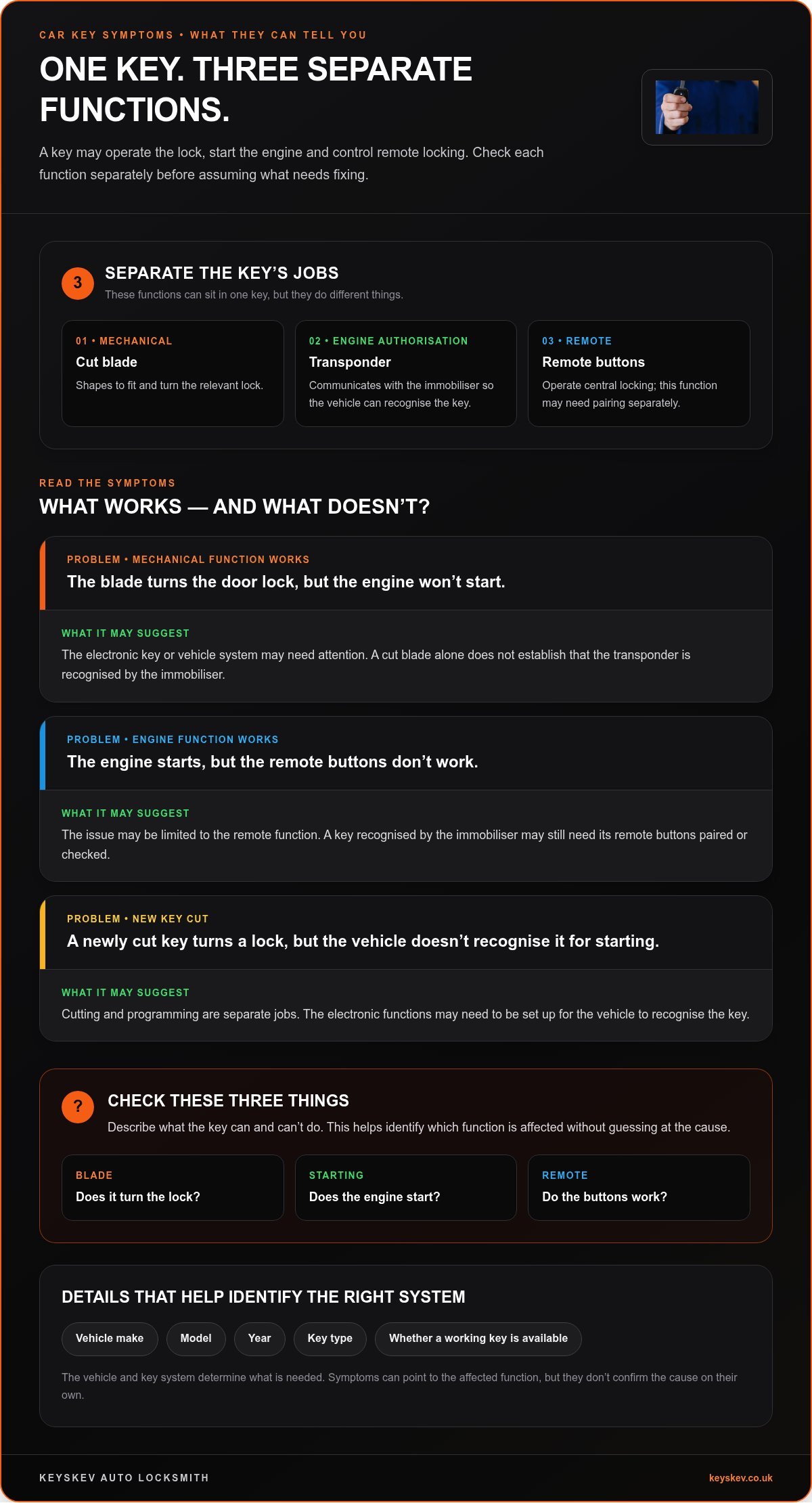
Does a replacement car key need cutting, programming, or both? It depends on the key and your vehicle. A cut blade turns a mechanical lock; a transponder communicates with the immobiliser, while remote buttons operate the central locking. These functions can sit in one key, but they don’t all do the same job. Car key programming sets up the electronic functions the vehicle needs to recognise.
If you’re unsure what’s gone wrong, start by checking which functions still work. A key that unlocks the doors may still fail to start the engine, and a newly cut key may need programming before the vehicle recognises it. The right fix starts with matching the key type and vehicle system to the problem, rather than guessing at a DIY process that may not suit your car.
This guide explains what car key programming does, when cutting is needed too, and how DIY, garage, dealer and auto locksmith options differ. You’ll also learn what details to have ready when arranging a replacement or spare, such as your vehicle’s make, model, year and whether you still have a working key. KeysKev Auto Locksmith provides mobile replacement and spare key cutting and programming, along with remote and flip keys, key cloning and module programming.
Key Takeaways
- Learn how programming lets a vehicle recognise an electronic key, and why cutting the blade alone may not be enough.
- Follow the typical stages, from identifying the vehicle to pairing and testing the key.
- Compare DIY, garage or dealer, and mobile auto locksmith options by equipment, compatibility and convenience.
- Use a simple checklist to describe your key and its symptoms clearly when arranging help.
- See how car key programming can support a replacement, spare, remote or transponder key.
What is car key programming, and what does it actually do?
Car key programming sets up a key’s electronic functions so the vehicle can recognise and respond to them. Depending on the key and the vehicle, programming may enable the engine to start, operate remote locking, or do both. It’s separate from cutting a key blade to fit a lock.
A programmed key has electronic credentials that the vehicle’s immobiliser recognises, allowing the vehicle to permit engine starting. The exact setup varies. Some keys contain a transponder for engine authorisation and buttons for remote functions; others use different electronic systems. So a key that unlocks the doors isn’t necessarily ready to start the car, and a key that starts the car may not operate the remote buttons.
This distinction helps narrow down the symptoms. If the blade turns the door lock but the engine won’t start, the electronic key or vehicle system may need attention. If the engine starts but the remote buttons don’t work, the problem may be limited to the remote function. These symptoms point to the function affected, but they don’t confirm the cause on their own.
How does a transponder key communicate with an immobiliser?
A transponder is a small electronic component in the key. When the key is used, the vehicle checks whether it recognises the transponder. The immobiliser is part of the vehicle’s anti-theft system. It can prevent the engine from starting if the required electronic authorisation isn’t recognised. The Immobiliser overview explains the system’s wider role in preventing unauthorised use.
Is key cutting the same as car key programming?
No. Cutting shapes a physical blade so it operates the relevant lock. Programming pairs electronic key functions with the vehicle. They’re separate jobs, even when both are needed for one replacement. A correctly cut blade might turn a door lock but still fail to start the engine if its transponder isn’t recognised.
For a key with a blade, transponder and remote buttons, the blade may need cutting to match the locks, while the electronic functions may need programming to work with the car. If you already have a working key, making a spare may involve different work from replacing all lost keys. The vehicle and key system determine what’s needed, so there isn’t one universal programming process.
Before arranging help, note what the key can and can’t do: does the blade turn the lock, does the engine start, and do the remote buttons work? That makes it easier to describe whether the issue appears mechanical, electronic or limited to remote operation. KeysKev provides replacement and spare key cutting and programming, including both tasks when needed.
How does car key programming work across different vehicle systems?
There isn’t one sequence that fits every car. The key type, vehicle age and security system affect how a technician accesses the vehicle’s electronics and pairs a key. In some cases, diagnostic equipment connects through the OBD-II port, usually found inside the vehicle. This is one possible access point, not a universal method.
A typical job can be understood in four stages:
- Identify the vehicle and key. The make, model, year and key type help establish which system is involved. A transponder key and a remote key may need different functions set up.
- Access the relevant system. The technician uses a suitable method to communicate with the vehicle’s key or security system. Depending on the vehicle, this may involve diagnostic equipment and the OBD-II port, or another procedure.
- Pair the key. The vehicle is set to recognise the key’s electronic information. If the key has remote buttons, those functions may need to be paired separately from the immobiliser function.
- Test the functions. The key is checked for the functions it is meant to perform, such as starting the vehicle or operating remote locking. Test each relevant function rather than assuming that one successful test proves they all work.
What role do the immobiliser and ECU play?
The immobiliser checks whether the key is authorised to start the vehicle. If the vehicle doesn’t recognise the required key signal, it can prevent the engine from starting. The ECU, or engine control unit, may be involved in the vehicle’s electronic system, but its role and interaction with key recognition vary. The procedure depends on the vehicle.
Why do programming methods vary by vehicle?
A key’s design, the vehicle’s age and its security system can all affect the programming method. Some procedures use diagnostic equipment, while others follow a different route. Don’t assume that instructions for one model will work for another, even if the keys look alike. Make- and model-specific steps need to match the vehicle being worked on.
During the final checks, distinguish between starting and remote locking. A key may be recognised by the immobiliser while its remote buttons still need attention. Likewise, working remote locking doesn’t show by itself that the key can start the engine. Describe which functions work or fail. That gives the technician a useful starting point without assuming the fault or promising a particular result.
KeysKev provides mobile replacement and spare key cutting and programming, as well as vehicle module programming. If you need help with a replacement or spare, mobile car key programming is one option.
DIY, garage or auto locksmith: which car key programming option fits?
The right route depends on the vehicle, the key and how much of the job you want to handle yourself. Owning a programming tool doesn’t guarantee that it supports your car or that the procedure will work. Compare compatibility, equipment and convenience before choosing.
If you’d rather have the key work carried out at the vehicle, mobile car key programming is a practical option. KeysKev provides mobile replacement and spare key cutting and programming, including remote and flip keys.
Can you programme a car key yourself?
Sometimes. Some vehicles allow a limited owner procedure, often with an existing working key. Others require specialist equipment or a different process. A guide for another make, model or year may not apply to your car. If the instructions don’t clearly match your vehicle, don’t assume a tool or online walkthrough will complete the job. Choose a route suited to the system.
Owning a programmer isn’t the same as having a suitable way to complete the work. Tools support particular vehicles or functions, so compatibility matters. A mismatch can waste time, especially if you’ve lost your key and can’t follow a procedure that relies on an existing one.
When is a mobile auto locksmith a practical option?
A mobile service can be useful when arranging a trip to a workshop is inconvenient, including when a replacement key is needed at the vehicle. It also offers a direct route for spare key work. The task depends on your vehicle’s system, so share its details and describe what the key does or doesn’t do when arranging help.
Consider your circumstances as well as the equipment. If you have the correct instructions, a suitable DIY procedure may be enough. If the vehicle needs specialist equipment, or you’d prefer the work handled at the car, a garage, dealer or mobile auto locksmith may be a better fit. Match the option to the specific key problem before deciding.
What should you check before arranging car key programming?
A few details can help match the work to the problem and avoid treating every key fault as a programming issue. Before arranging help, note your vehicle, the type of key you have and exactly what happens when you use it.
Which details help identify the right key service?
Start with the vehicle’s make, model and year. Note whether the key is a standard transponder, remote or flip key, and whether you still have a working one. The vehicle identification number (VIN) can also help identify the vehicle’s specification. You’ll usually find it on vehicle documents or displayed on the car. Share it accurately, and don’t guess if you’re unsure.
- Vehicle: make, model, year and, if available, VIN.
- Key: standard, remote or flip key; say whether it’s damaged or missing.
- Working keys: note whether you have another key that starts the car or operates the remote.
- Symptoms: describe what happens when you try to start the vehicle and use the remote buttons.
- Recent changes: mention visible damage or whether the issue began after the key was dropped or exposed to water.
Be precise about the main problem. Does the engine fail to start, does remote locking stop working, or are both affected? If the key is lost altogether, say whether you have a spare. That helps distinguish a replacement request from a fault affecting a key you still have.
Could the fault be something other than programming?
Yes. If the remote buttons stop responding but the car still starts, the issue may be limited to the remote function. A depleted key-fob battery or physical damage can also affect how a key behaves. If the engine won’t start, note any warning messages and whether another key works. Symptoms help describe the problem, but they don’t confirm its cause.
Keep troubleshooting brief. Check for obvious damage and, where appropriate, whether the fob battery needs attention. Don’t assume that a new battery or programming will fix every symptom. If you’ve lost your key, compare the practical lost car key replacement options before deciding what information to provide.
Clear notes make it easier to arrange the right key work. KeysKev provides mobile replacement and spare key cutting and programming. Arrange mobile car key help with KeysKev when you need assistance with a replacement or spare.
How KeysKev helps with car key programming and replacement keys
The right key service depends on what you need the key to do. A lost key calls for a replacement, while a working key may make a spare the practical choice. If the transponder or buttons are involved, the work may need to address those electronic functions too. KeysKev provides mobile auto locksmith services, including replacement and spare key cutting and programming.
Replacement key, spare key or remote fob: what can KeysKev help with?
KeysKev works with remote and flip keys, transponders, replacement keys and spares. Depending on the vehicle and key, the work may involve cutting a blade, programming electronic functions, or both. A transponder key and a remote fob don’t necessarily serve the same purpose, and vehicles can use different key types and processes.
Be clear about your situation when arranging help. Say whether all keys are lost or you still have a working one, and whether you need a spare or replacement. Describe whether the key starts the vehicle, operates remote locking, or does neither. Those details help shape the appropriate job without assuming the cause.
KeysKev also provides key cloning. Cloning is a separate option from arranging a new replacement key, and which approach fits depends on the key and vehicle system. Sharing the vehicle’s make, model and year, along with the key type and symptoms, gives a useful starting point.
What happens when the issue involves a vehicle module?
Sometimes the work concerns the vehicle’s electronic system, not just pairing a key. A fault may involve a module such as an ECU or BCM, depending on the vehicle. Module programming is a specialist job distinct from basic key pairing. KeysKev provides vehicle module programming, as well as key cloning. The system involved and the symptoms help determine the work required.
For Mercedes vehicles, EIS and ESL steering lock repairs are specialist examples. These systems aren’t the same as a standard remote-button issue, so describe any warning signs and what the key does. Don’t assume that programming alone will resolve a fault affecting a vehicle module or steering lock.
To make the first conversation useful, have your vehicle details ready and explain what you need: a replacement, a spare, help with a remote or transponder key, or assistance with a module-related issue. KeysKev’s mobile service brings key cutting and programming to the vehicle. The work depends on the vehicle and key system, so clear details help establish the right job.
Contact KeysKev about car key programming to discuss your replacement, spare or key-related issue.
Take the next step with confidence
Before arranging help, decide what you need the key to do and describe the issue plainly. Is it a lost key, a spare you’d like made, or a key that no longer starts the vehicle or operates its remote? Clear details help focus the conversation on the right car key programming or replacement work.
KeysKev provides a 24/7 mobile auto locksmith service, with replacement and spare key cutting and programming, remote and flip keys, transponders, key cloning and module programming. The right work depends on your vehicle and key system, so share the make, model and year, along with the functions affected.
You don’t need to guess at the technical fault before asking for help. Explain what you’ve tried and what still works, then take the next step with the details to hand. Contact KeysKev about car key programming to discuss your key issue.
Frequently Asked Questions
Can a car key be programmed without the original?
Yes, a replacement key can sometimes be programmed without the original. The method depends on the vehicle’s security system and the replacement key. If every key is lost, say so when arranging car key programming rather than describing it as a spare. Have the make, model and year ready, and mention whether any key remains that can unlock or start the vehicle. Don’t rely on instructions written for a different model.
What happens if a new car key is cut but not programmed?
A newly cut key may turn a mechanical lock but fail to start the vehicle if the car doesn’t recognise its electronic component. Remote buttons may also need attention separately. For example, a key might open the driver’s door but not start the engine or operate central locking. Explain which actions work and which don’t when arranging the job, so the required key functions are clear.
Does programming a new car key erase the old one?
It depends on the vehicle system and the procedure used. Some programming processes may change which keys the vehicle recognises, but the effect isn’t the same for every car. If you have other working keys, mention them before work begins and explain which keys you still need to use. The expected effect should be explained for your vehicle and situation, rather than assumed from a general guide.
Can a car key stop working because its battery is flat?
Yes, a weak or flat fob battery can stop remote buttons working. That doesn’t necessarily mean the transponder has lost its pairing with the immobiliser. Note whether the key still starts the car, operates remote locking, or does neither. For instance, if starting still works but the buttons don’t, report that difference. Symptoms help describe the problem, although they can’t identify the fault on their own.
How many keys can be programmed to one car?
There isn’t one key limit for every vehicle. The number depends on the car’s make, model, year and security system. If you want another spare, or have several keys that need to remain usable, list how many you currently have and how many you want to use. A limit quoted for a different vehicle may not apply, so don’t treat a general online figure as a rule for your car.
Is car key programming the same as key cloning?
No, the terms describe different approaches. Programming sets up a key’s electronic functions for the vehicle, while cloning copies key data from an existing key when that method suits the system. For example, cloning may be considered when a working key is available and a duplicate is needed. It isn’t automatically suitable for every vehicle or lost-key situation. The key type and vehicle system determine which approach is relevant.


