
What if the safest way to unlock your car is to pause before trying a tool? When keys are trapped inside or out of reach, car door unlocking can feel urgent. Forcing the door or tampering with the lock can turn a simple lockout into costly damage.
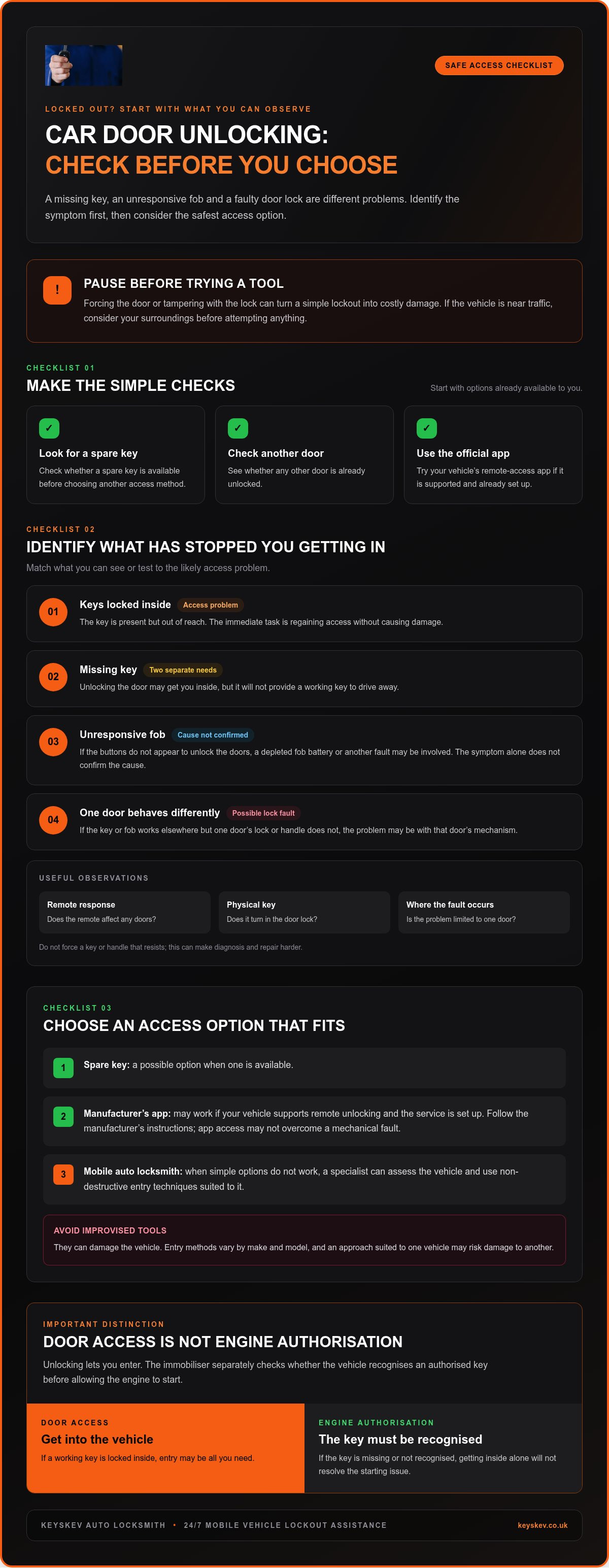
It’s frustrating when you can’t tell whether the problem is a missing key, a flat key-fob battery, a faulty lock or central locking that isn’t responding. Start with simple checks: look for a spare key, check whether another door is unlocked, and use your vehicle’s remote-access app if it’s already set up.
This guide explains why car doors may stay locked, which options to try first, and when to stop and get specialist help. You’ll also learn how a mobile auto locksmith can use non-destructive entry techniques to help restore access while limiting the risk of damage to the door, lock or electronics.
Key Takeaways
- Identify whether you’re dealing with keys locked inside, a missing key, a failed fob or a faulty door lock before choosing an access option.
- Remember that unlocking the door and authorising the engine to start are separate functions in many vehicles.
- Compare a spare key, your vehicle’s official app and professional car door unlocking. Improvised tools can damage the vehicle.
- Make a few safe checks first, including considering your surroundings if the vehicle is near traffic. Don’t force the door or tamper with the lock.
- When simple options don’t work, KeysKev provides 24/7 mobile vehicle lockout assistance using non-destructive entry techniques.
What does car door unlocking involve when you are locked out?
Car door unlocking means restoring access when a vehicle’s doors are secured and you can’t get in. It’s different from replacing a lost key or programming a new fob, although you may need those services if the key is missing or faulty.
Definition: A vehicle lockout is an access problem: the key or another authorised way to unlock the doors is unavailable. A key fault or lock-system fault is a problem with the equipment used to gain access.
The distinction matters. If a key is locked inside, you may need entry without a replacement key. If the key is lost, unlocking the door won’t give you a working key to drive away. A failed fob or stiff lock may need diagnosis before anyone chooses an access method. The safest option depends on the vehicle and what has stopped you getting in.
Is it a lockout, a key problem, or a door-lock fault?
Start with what you can observe. If you can see the key inside, or know it has been left in the vehicle, the immediate problem is access. If the key is missing, unlocking the door may get you in, but it won’t provide a working key to start the car.
- Keys locked inside: The key is present but out of reach. The task is to regain access without causing damage.
- Missing key: You can’t use the usual key or fob. Getting into the vehicle and replacing the key are separate needs.
- Unresponsive fob: The buttons don’t appear to unlock the doors. A depleted fob battery or another fault may be involved, but the symptom alone doesn’t confirm the cause.
- Door-lock fault: A key or fob may work elsewhere, while one door’s lock or handle won’t operate as expected. This can point to a mechanism problem rather than a simple lockout.
Notice whether the remote affects any doors, whether a physical key turns in the lock, and whether the problem is limited to one door. These details help distinguish an access issue from a fault. Don’t force a key or handle that resists, as this can make diagnosis and repair harder.
Why can modern car doors need specialist entry?
Many vehicles combine electronic central locking with physical locks and vehicle-specific security systems. A fob signal may command the doors to unlock, while a mechanical key may operate a lock directly. The arrangement, door construction and parts behind the outer panel vary between vehicles.
There isn’t one reliable method for every make and model. An approach suited to one vehicle may be ineffective or risk damage to the paint, seals, lock components or electronics of another. A mobile auto locksmith can assess the access problem and use non-destructive entry techniques suited to the vehicle, rather than treating every lockout as the same job.
How do car door locks and remote unlocking systems work?
A car’s entry system can combine mechanical parts, electronic controls and anti-theft technology. Knowing what each part does helps explain why a door may unlock but the engine still won’t start, or why a remote command might fail even when the key itself is usable. The details vary by vehicle, so the same symptom can have different causes.
What do the key, fob, and central locking each do?
A physical key operates a mechanical door lock where the vehicle has one. A remote fob sends a coded signal to the vehicle’s locking system when you press a button. Central locking coordinates the locking or unlocking of multiple doors, although the controls and behaviour depend on the vehicle’s design.
These parts don’t all perform the same job. A key may turn in a door lock even if the fob battery is flat. A fob may operate the central locking without using the mechanical lock. If one door behaves differently from the others, that may point to a problem with that door’s mechanism rather than the remote signal.
Can a car app unlock the doors without the key?
Some vehicles support remote unlocking through a manufacturer’s app. Whether it works depends on the vehicle’s equipment, connected services and account setup. Use the official app and follow the manufacturer’s instructions. Don’t assume the feature is available just because another model from the same manufacturer supports it.
An app sends a remote command, but it can’t necessarily overcome a mechanical problem. If the vehicle has a faulty lock, a damaged door mechanism or an issue with its connected system, app access may not restore entry. A failed command also doesn’t, by itself, identify which part has a fault.
Door access and engine authorisation are separate: unlocking lets you enter, whilst the immobiliser checks whether the vehicle recognises an authorised key before allowing the engine to start.
The immobiliser is an anti-theft system linked to the vehicle’s key or transponder. Depending on the vehicle, the key may contain a chip that the car checks when you try to start it. A remote fob can unlock the doors without necessarily resolving a problem with that recognition process. Equally, a key that starts the engine may not make a remote button work if the fob’s battery or remote function has failed.
This distinction matters during car door unlocking. If you’ve locked a working key inside, entry may be all you need. If the key is lost, or the vehicle won’t recognise it after you get in, access alone won’t solve the starting issue. KeysKev provides mobile vehicle lockout assistance using non-destructive entry techniques to help restore access while limiting the risk of damage.
Car door unlocking options compared: spare key, app, or locksmith
The right option depends on what’s available and why the door won’t open. A spare key or supported manufacturer app may suit a straightforward lockout. If neither is practical, or the locking system appears faulty, professional help can reduce the risk of damage. Use this comparison to choose a sensible next step.
Spare key
Suitable when: Someone can bring you a working spare and reach the vehicle safely.
Limitations: It won’t help if the spare is also inside, unavailable or faulty. It also won’t fix a problem with the door mechanism.
Manufacturer app
Suitable when: Your vehicle supports remote unlocking, the service is set up and you can access the official app.
Limitations: Features vary by vehicle and connected-service setup. An app command may not resolve a mechanical lock fault or another vehicle problem.
Mobile auto locksmith
Suitable when: A spare or app isn’t a practical option, or you’re unsure whether the issue is access-related or a fault.
Limitations: A locksmith restores access, but a missing key or separate fault may need additional work. The right approach depends on the vehicle and symptoms.
When is a spare key or manufacturer app the simplest option?
A spare key is often the most direct choice if it can be brought to you safely. Use the manufacturer’s official app only if remote unlocking is supported and already set up for your vehicle. If the command fails repeatedly, or the door still won’t open with a working key, don’t assume another attempt will solve it. The cause may need proper assessment.
Why avoid coat hangers, wedges, and other improvised tools?
Improvised tools can slip, scratch paint, damage rubber seals or put pressure on lock components. Reaching into a door without knowing its layout may also affect internal mechanisms or wiring. Vehicles differ in their construction, so a method that appears to work on one car may cause harm on another. Don’t force a window, door or lock that resists. Stop if an attempt risks damage.
For safer car door unlocking, avoid probing the door with household tools. A mobile auto locksmith uses non-destructive entry techniques suited to the vehicle, aiming to restore access without damaging the door or locking system. If simple options aren’t suitable, mobile vehicle lockout assistance is a practical next step.
What to check before attempting car door unlocking
Pause before trying to open the vehicle. A few checks can reveal a safe, ordinary way in, but they shouldn’t involve forcing a door or interfering with the lock. Your safety comes first, especially if the car is beside a busy road or somewhere passing traffic could put you at risk.
Use this brief sequence:
- Check your surroundings. Move to a safe place away from traffic before inspecting the vehicle. Don’t walk around the car or stand beside a live lane to reach another door.
- Check each passenger door and the boot or hatch. Look for normal, unlocked access only. Don’t pull hard on a handle or climb through an opening.
- Consider your key and app. If you have a spare key nearby, ask someone to bring it if that can be done safely. Try the manufacturer’s app only if your vehicle is set up for remote unlocking.
- Consult the handbook. Follow the model-specific instructions for the key or locking system rather than guessing at controls or procedures.
Which safe checks may resolve a simple access problem?
A passenger door or the boot may be unlocked, so check each opening without applying force. If you use an app, follow the manufacturer’s official instructions and note whether the vehicle responds. The handbook may explain controls that aren’t obvious. If none of these checks provides normal access, stop there. Repeated commands or pulling at a resistant handle won’t identify the fault.
When should you stop and get specialist help?
Stop if an attempt could damage glass, paint, rubber seals or lock parts, or if opening the door would put you near moving traffic. If a person or animal inside faces immediate danger, call emergency services rather than delaying to try other access options. Persistent problems with a key, fob or central locking may need diagnosis as well as entry.
A lockout and a system fault can look similar at first. For example, if the remote doesn’t respond and the door also resists a physical key, more attempts may increase the risk of damage without clarifying the cause. A mobile auto locksmith can assess the access problem and use non-destructive entry techniques to help regain access. If safe checks haven’t worked, arrange mobile vehicle lockout assistance instead of forcing the door.
How KeysKev approaches non-destructive car door unlocking
If you’ve tried the safe, normal options and still can’t get into your vehicle, KeysKev Auto Locksmith provides 24/7 mobile vehicle lockout assistance. The aim is to restore access using non-destructive entry techniques, rather than forcing a door or relying on improvised tools.
Every vehicle has its own door construction and locking arrangement. The right approach depends on the vehicle and the access problem. A key locked inside is different from a door that won’t respond to the remote or a lock that appears faulty. Treating these as the same issue can lead to unnecessary attempts and possible damage.
What does non-destructive entry mean for your vehicle?
Non-destructive entry means aiming to regain access while avoiding damage to the vehicle. The technique must suit its doors and locking system; there isn’t one method for every make and model. It’s a careful alternative to forcing the door, window or lock. Although the goal is to avoid damage, no approach should be treated as a guarantee that damage is impossible in every circumstance.
For car door unlocking, the immediate task is access. It’s separate from replacing or programming a key. If the key is missing, or the vehicle doesn’t recognise it after entry, you may need key-related work as well. Keeping these needs distinct helps avoid expecting an unlocking service to solve a separate key or starting fault.
When can a mobile auto locksmith help with a locked door?
Call a mobile auto locksmith when a spare key or supported manufacturer app hasn’t restored normal access, or when the lock’s behaviour suggests a fault. KeysKev Auto Locksmith provides 24/7 mobile vehicle lockout assistance using non-destructive entry techniques to help drivers regain access. If the key itself is lost or faulty, access and key replacement or programming are separate requirements.
Trying to force a resistant door can cause damage without resolving the cause. A specialist can focus on the vehicle’s access problem and use an approach suited to its locking system. The aim is practical: regain access while limiting the risk to the door, lock and surrounding parts.
If you’re still locked out, get help with a vehicle lockout from KeysKev Auto Locksmith.
Take the next step with confidence
Once you know the door is the immediate problem, focus on getting access without creating another one. Before arranging help, be ready to explain what you observed: whether the key is locked inside, lost, or present but not responding, and whether the fault affects one door or the whole locking system. Share the vehicle make and model if you know them. Mention whether the official app or physical key produced any response. These details help describe the access problem clearly.
Don’t keep trying methods that require force. If the vehicle opens but the key still won’t start it, mention that too. Door entry and key recognition are separate concerns and may need different work. Keeping that distinction clear helps you choose the right next step instead of treating every symptom as a door lockout.
For practical help with car door unlocking, get help with a vehicle lockout. Contact KeysKev for 24/7 mobile vehicle lockout assistance using non-destructive entry techniques.
Frequently Asked Questions
Can a car door be unlocked without the key?
Yes, a vehicle can sometimes be opened without using its key, for example through a supported manufacturer app or professional assistance. The suitable option depends on the vehicle and why the key isn’t available. If the key is lost rather than locked inside, remember that opening the door won’t provide a key to start the car. A mobile auto locksmith can help with access, and lost or faulty keys may need replacement or programming.
Is it safe to use a coat hanger to unlock a car door?
No. A coat hanger can scratch the paint, tear a door seal or interfere with parts inside the door. It may also fail to open the vehicle, leaving you with damage and the original lockout. Don’t push tools into gaps or try to manipulate the lock. If the door won’t open through normal means, stop and use a suitable access option instead.
Can a car manufacturer’s app unlock the doors remotely?
Some manufacturer apps can send an unlock command, but this depends on the vehicle’s supported features and the connected service being set up. Check the official app and the vehicle handbook for instructions. An app set up by a previous owner, for instance, may not be available through your account. If the app reports an error or the vehicle doesn’t respond, it may not resolve the cause.
What should I do if my key fob will not unlock the car?
First, check whether the fob’s buttons feel damaged and whether the vehicle responds to any command. If you have a spare fob, compare its response. Your handbook may explain how to use the physical key or replace the fob battery for your model. Don’t assume a silent fob means the door lock itself has failed. If normal checks don’t help, describe the symptoms to an auto locksmith.
Can a locksmith unlock a car door without damaging it?
A locksmith can use non-destructive entry techniques intended to restore access while avoiding damage. The method depends on the vehicle’s design and the issue, so no approach should be treated as a guarantee in every situation. KeysKev Auto Locksmith provides mobile vehicle lockout assistance. If you’re locked out, explain whether the key is inside, missing or failing to operate the locks so the access problem is clear.
What if my car door will not unlock even with the key?
If the key won’t turn, don’t force it. A bent, worn or damaged key may not operate the lock correctly, while resistance can also point to a problem with the mechanism. If the key works in another door, note that difference. Avoid repeated twisting, which could damage the key or lock further. A locksmith can help regain access, though a persistent fault may need separate diagnosis.
Can I unlock my car through the boot or hatch?
Only if the boot or hatch opens normally and provides safe access to the cabin. Check the vehicle handbook before using any internal release, as its location and operation differ by model. Don’t climb through a small opening, force a hatch or try to defeat a lock. If the boot is also locked, or entry would be unsafe, stop and arrange professional help rather than risking injury or damage.


