

What if a car remote that won’t lock or unlock doesn’t need reprogramming at all? A weak or incorrectly fitted battery can cause similar symptoms, whilst a fault with the fob or vehicle may need a different fix. Car remote fob programming pairs the remote with the vehicle, but it isn’t a universal cure.
If the buttons have stopped working, it’s understandable to wonder whether to replace the battery or try a sequence found online. The right steps depend on the vehicle, and an incorrect procedure can waste time. Some cars allow owners to programme remote functions; others need specialist equipment. The transponder that lets the engine start may also be separate from the remote buttons.
This guide explains what programming does and doesn’t do, and which safe checks to try first, including testing a spare fob and checking the battery. You’ll also learn when to stop rather than follow instructions that may not suit your car. If basic checks don’t solve the problem, KeysKev Auto Locksmith provides mobile car key programming, as well as remote and flip keys, replacement keys and key cloning.
Key Takeaways
- Separate remote locking and unlocking from the transponder function that authorises the engine to start.
- Check the fob’s battery, visible condition and response close to the vehicle before looking for a programming fault.
- Some cars have an owner-manual procedure for car remote fob programming; others need diagnostic equipment or security access.
- Before attempting any steps, note your vehicle’s make, model, year, fob type and the exact fault.
- If a vehicle-specific procedure fails or a replacement fob needs pairing, mobile professional programming may be the practical next step.
What does car remote fob programming actually do?
Car remote fob programming pairs a fob’s remote-control functions with the vehicle. It allows the vehicle to recognise commands from that fob, such as locking or unlocking the doors where those functions are fitted. The process doesn’t automatically programme every electronic part of a key.
Car remote fob programming pairs a vehicle with a fob for remote commands; it isn’t a universal procedure and doesn’t necessarily authorise the engine to start. That distinction matters if the buttons work but the car won’t start, or the engine starts but the remote buttons don’t respond. The Key fob overview gives useful background on the device, but a vehicle’s functions depend on its design.
| Function | What it does | What it doesn’t confirm |
|---|---|---|
| Remote fob | Sends button commands, such as locking or unlocking, where fitted. | That the engine-start authorisation is programmed. |
| Transponder key | Communicates with the immobiliser so the vehicle can authorise starting. | That the remote buttons will operate. |
| Keyless entry | On vehicles with this feature, allows access without pressing a conventional lock or unlock button. | That every fob or key function is working correctly. |
Which functions does a remote fob control?
Button layouts vary. One fob may have separate lock and unlock buttons; another may include additional vehicle-specific controls. When you press a button, the fob sends a command. The vehicle responds only if it recognises the fob and the relevant function is fitted. A lack of response doesn’t, by itself, prove that the key needs programming. The button, battery, fob or vehicle could be involved.
If it’s safe and practical, test each button separately and note the results. If one works but another doesn’t, that points to a different symptom from a fob that gets no response at all. Working door buttons don’t prove that the key can start the engine.
How is a remote fob different from a transponder key?
A transponder is an electronic component in a key that communicates with the vehicle’s immobiliser. The immobiliser uses that communication to authorise engine starting. This is separate from the remote’s lock and unlock commands, even when both functions are built into the same key. Pairing the buttons doesn’t necessarily programme the transponder.
If the remote works but the car won’t start, or the key starts the car but its buttons fail, treat these as distinct faults. One programming step may not fix both. The separate topic of transponder key programming covers the engine-authorisation side; the work required depends on the vehicle and key system.
Why has your car remote fob stopped working?
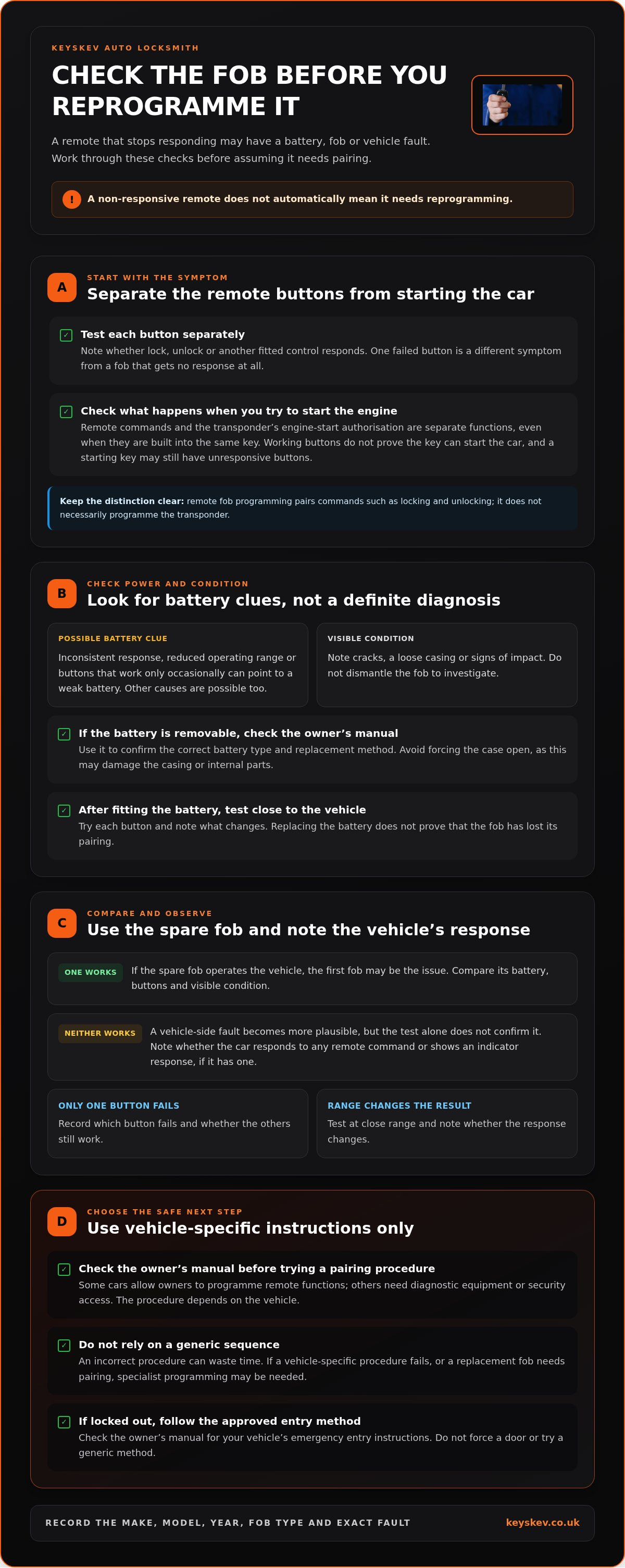
A fob that stops responding can be frustrating, but the cause may be simpler than a programming fault. Start with the basic checks before trying vehicle-specific steps. A non-responsive fob doesn’t automatically mean it needs reprogramming.
Could the fob battery be the problem?
A weak battery may cause inconsistent response, reduced operating range or buttons that work only occasionally. These signs can have other causes, so treat them as clues rather than a definite diagnosis. If the fob has a removable battery, check your vehicle owner’s manual for the correct type and replacement method. Avoid forcing the case open, as this may damage the casing or internal parts.
Replacing the battery doesn’t prove that the fob has lost its pairing. Once you’ve fitted the battery as instructed, test the fob close to the vehicle and try each button. If it still fails, continue checking rather than repeating the battery change or jumping straight to a reprogramming procedure.
How can you tell whether the fault is with the fob or car?
Look for a pattern. If one button fails whilst another still works, the issue may be limited to that button or its contact. If every button is unresponsive, the battery, fob or vehicle could be involved. Visible cracks, a loose casing or signs of impact are useful clues, but don’t dismantle the fob to investigate.
Try the spare fob if you have one. If it operates the vehicle, that points towards an issue with the first fob. If neither fob works, a vehicle-side fault becomes more plausible, though the test alone doesn’t confirm it. Check whether the vehicle responds to any remote command or shows an indicator response, if it has one. Test at close range too, and note whether the result changes.
If you’re locked out, check the owner’s manual for the vehicle’s approved emergency entry method. Follow the instructions for your model rather than forcing a door or trying a generic method.
Use this checklist to keep the symptoms clear:
- One fob works, one doesn’t: compare the unresponsive fob’s battery, buttons and visible condition.
- Neither fob works: note whether the vehicle responds to any remote command or indicator.
- Only one button fails: record which button and whether the others still work.
- Response changes at close range: note the difference before seeking further help.
These observations can help distinguish a fob problem from a possible vehicle-side fault. If basic checks don’t resolve it, KeysKev provides mobile car key programming for drivers who need specialist help with a remote or replacement key.
Can you programme a car remote fob yourself?
Sometimes. Some vehicles include an owner-led procedure for pairing remote buttons. Others need diagnostic equipment or authorised security access. There isn’t one ignition sequence that works across every make and model, so online steps for a different car can waste time or cause confusion.
Replacing a fob or its battery doesn’t guarantee that you can pair it yourself. A battery change may leave the existing pairing untouched, whilst a replacement fob may need vehicle-specific programming. The key question is whether your exact vehicle supports an owner procedure for the function that has stopped working.
| Approach | Advantages | Limits |
|---|---|---|
| Owner-manual procedure | Can be convenient if the vehicle provides clear steps for the specific remote function. | Only applies to the stated vehicle and procedure. It may not cover transponder or immobiliser programming. |
| Specialist programming | Can use diagnostic equipment and vehicle-specific security access when an owner procedure isn’t available or doesn’t work. | Requires suitable equipment and knowledge of the vehicle’s system. |
When is an owner-led procedure worth trying?
Use the owner’s manual for your exact make, model and year. Confirm that the instructions cover your fob type and the function you’re trying to restore. Follow those steps and stop if the sequence doesn’t match your vehicle or the expected response doesn’t happen. Don’t substitute an online routine from another model. A remote-button procedure shouldn’t be assumed to programme the transponder or immobiliser.
When does programming need specialist equipment?
Some vehicle systems require diagnostic access or security credentials to pair a key. A specialist uses appropriate programming equipment to communicate with the vehicle and carry out the process required for its system. This is different from trying generic button or ignition combinations, and it doesn’t involve bypassing vehicle security. The broader subject of car key programming includes the different key functions and methods involved.
If the manual has no matching procedure, or the stated steps fail, avoid repeated attempts based on guesswork. Note the vehicle details, fob type and what happens when you press each button. This information helps distinguish a remote-pairing issue from a need for another type of key programming.
In short, car remote fob programming may be possible at home only when your vehicle provides a suitable owner procedure. Check the manual first. If the vehicle requires specialist access, stop there and use professional programming rather than trying to work around its security system.
How to approach car remote fob programming safely
Prepare the facts before trying to pair a fob. Vehicle systems differ, and a procedure written for another model may not apply. Exact vehicle details help identify the correct fob, programming method and system before pairing begins.
Use this checklist to gather information. It isn’t a universal reprogramming sequence.
- Identify the vehicle. Record the make, model and year from the vehicle documents or identification details. If you’re unsure of the model year, check the documents rather than guessing.
- Describe the fob. Note whether it’s an existing, replacement or spare key, and whether it’s a remote or flip-key style. Include any identifying information printed on the fob, if visible.
- Write down the fault. Say which buttons work and which don’t. Note whether the vehicle responds to any remote command, whether the key starts the engine and whether a warning appears on the dashboard.
- Check the owner’s manual. Look for a manufacturer-approved owner procedure that matches your exact vehicle and fob. Don’t substitute instructions for a similar-looking model.
- Stop if details don’t match. If the manual’s steps or expected response differ from your vehicle, don’t improvise or repeat unrelated online sequences. Keep your notes for a specialist.
What information should you gather first?
Be precise about what has changed. For example, note whether the fob used to unlock the vehicle but now only one button works, or whether a replacement fob has never operated it. Include any dashboard message in its exact wording. These details help separate a remote-button issue from a starting or vehicle-system fault, and give the programming process a clear starting point.
What should you expect during professional programming?
A specialist identifies the fob type and relevant vehicle system before pairing. The vehicle may need to be present so its system can be accessed and the fob’s operation checked. The required process depends on the vehicle, so the steps and outcome can vary. Programming isn’t a single sequence that works for every car.
KeysKev provides mobile car key cutting and programming, including remote and flip keys. If you’ve gathered the details but still need help, arrange professional car key programming rather than attempting a procedure that doesn’t match your vehicle.
When to call KeysKev for car remote fob programming
Consider specialist help if the owner-manual procedure for your exact vehicle has failed, the fob is visibly damaged, or a replacement remote needs pairing. These situations may involve more than a battery change or a simple button check. Repeating steps that don’t match the vehicle is unlikely to clarify the fault.
It’s also sensible to stop if the buttons work but the vehicle won’t start, or if a new key operates the engine but not the remote functions. Those symptoms can involve different parts of the key system. Clear notes about what works and what doesn’t help keep the next step focused.
What can a mobile auto locksmith help with?
KeysKev provides mobile car key cutting and programming, including remote and flip keys. If a replacement or spare key needs programming, this can be a practical route when an owner-led procedure isn’t available or hasn’t worked. The right process depends on the vehicle and key involved.
Lost or damaged keys may call for a replacement, whilst a spare can provide another working key. Key cloning may be relevant when creating a duplicate. These are different needs, so describe the issue rather than assuming every fault requires the same programming step. No single process suits every vehicle.
What should you do before requesting help?
Have the vehicle make, model and year ready, along with a short account of the fault. Say whether the fob is existing, damaged, replacement or spare, and note which buttons respond. Mention any dashboard warning and whether the key starts the vehicle. If you have another working key or fob, say so, as it helps clarify what is affected.
- Record the exact vehicle details.
- Describe what works and what fails.
- Note whether another working key is available.
- Keep any replacement fob details to hand.
That information gives KeysKev a clearer picture of the car remote fob programming issue. If your checks haven’t resolved it, contact KeysKev for mobile car key help.
Get the right help for your next step
A key problem is easier to address when you know what you need restored: remote access, engine starting, or both. Before arranging work, decide which function matters most right now and keep any working key safe. That gives you a clear starting point without adding confusion through trial-and-error procedures.
If car remote fob programming still seems necessary, KeysKev provides a 24/7 mobile auto locksmith service across the UK. The service includes car key cutting and programming for remote and flip keys, whether you need a replacement or another key. The specific process depends on your vehicle.
Don’t keep trying steps that don’t match your car. Get practical help with your vehicle’s key issue. Contact KeysKev for mobile car key programming, and take the next step with confidence.
Frequently Asked Questions
Can a car remote fob be reprogrammed without the original key?
Possibly, but it depends on the vehicle’s security system and the fob. Some vehicles require an already working key for an owner-approved procedure; others need specialist diagnostic access to add another one. Check the handbook for instructions that match your exact model before attempting car remote fob programming. If the manual doesn’t cover your situation, or the steps are unclear, professional programming can help identify the appropriate next step.
Can a used car remote fob be programmed to another car?
Sometimes, but a used fob isn’t automatically suitable for another car. Reuse depends on its design and the receiving vehicle’s security system. Some fobs may be programmed again, whilst others may remain tied to their original vehicle or be incompatible. Compare the fob’s identifying details with the exact make, model and year before trying anything. Don’t assume a similar-looking fob will work.
Does changing a car fob battery erase its programming?
Changing the battery doesn’t automatically erase a fob’s pairing. The effect can depend on the fob and vehicle design, so follow the handbook’s instructions for opening the case, fitting the specified battery and closing it correctly. Then test the buttons near the vehicle. If the response remains inconsistent or absent, the battery may not be the only issue. Note which functions fail before deciding on further checks.
Why does my car remote fob work intermittently?
Intermittent response can have several causes, including a weakening battery, physical damage, signal interference or a vehicle-side issue. Try the fob close to the car, then compare its response with a spare if you have one. If both fobs behave the same way, the fault may not be isolated to one remote. If the problem persists or affects multiple fobs, arrange professional diagnosis rather than repeatedly pressing the buttons.
Is a remote fob the same as a keyless entry system?
No. A remote fob usually sends commands when you press buttons, such as locking or unlocking. Keyless entry may describe a system that recognises a fob without button presses, but this feature isn’t fitted to every vehicle. Some keys combine both types of access. Check the handbook for your model to see which functions it supports and how they should operate.
What should I do if my car remote fob is lost but the car still starts?
If the car starts, the missing item may be a remote fob rather than the key or transponder that authorises starting, but designs differ. Check whether you have a separate spare and consult the handbook for the correct steps for your model. A specialist can assess replacement and programming options. Don’t assume the missing fob can always be deleted from the vehicle’s memory; that depends on its system.


